Northern Italy - Anno Domini 2017
Right on the Swiss border...
Actually, Austria isn’t far away either...
Summer...
To be more specific, August...
Even more precisely, August 11th, 2017...
| ||

But let’s rewind about 5-6 days (cue the Hollywood-style
flashback):
We’re vacationing in southern Italy, and I’m cycling every day or almost every
day for an hour or two, depending on how much time I can squeeze in between
morning and afternoon swims—always after lunch.
It’s hot, over 40°C every day, but I tell myself that’s normal. We’re in
southern Italy, by the sea—this is how it should be, right?
The terrain is flat as a pancake, and at some point, out of sheer
desperation over how flat it is, an idea strikes me: why not tackle Passo dello
Stelvio on the way back?
I get goosebumps at the thought (in a good way, of course), and the gears in my
head start turning.
I try to find accommodation...
No luck.
I mean, there is, but for outrageously high prices.
Unexpectedly, finding a place to stay becomes a real nightmare.
It’s completely unjustifiable (not to mention insane) to pay for
two nights in northern Italy the same amount as our entire 10-day vacation in
the south—or even more.
The search continues with little visible success.
Giving up isn’t an option, but my optimism starts to wane as time passes.
Persistence, however, always pays off in one way or another...
Of course, my standards gradually drop, and eventually, I find a place about
140km from the start of the Stelvio climb (I think to myself, "140km
there, climb Stelvio, descend, and then 140km back—this is going to be quite
the adventure").
In a 250km radius around Stelvio, this is the best option when you factor in
the price, distance, quality of accommodation, and all the essential details
(like parking for the car, WiFi, etc.).
I book through Booking.com—no turning back now (though honestly, that’s not a
bad thing at all).
I’m fully aware that I only have one day to tackle Stelvio (as the English
would say, a “one shot”), and if the weather isn’t good... well, better not
even think about that.
I keep an eye on the forecast, find a weather station for Stelvio, and see that
the temperature peaks at around 15°C. I tell myself, “Okay, not bad, actually
quite nice.”
Fast forward to the day before the ride... We’re leaving southern Italy and by
late afternoon, we arrive in San Cristoforo, on the shores of Lago di
Caldonazzo.
Of course, as soon as we settle in, I say, “I’m off to do a loop around the
lake, just to warm up for tomorrow.”
 | ||
|
A Look at the Sky as Soon as I Stepped Out of the Hotel The clouds don’t look promising. After just 1-2km from the
hotel, it starts drizzling. I don’t care, I keep going, but the drizzle soon
turns into a full-blown downpour.  The rain shows no signs of stopping—if anything, it gets worse.
|

I ride on. The sky is gloomy, black clouds threaten from all sides, and occasionally, a light drizzle reminds me not to relax too much.
Despite it all, I’m still enjoying myself... The humidity is at 100% (everything is wet and steaming).

Honestly, it’s a shock to my system. Just this
morning, I was in southern Italy where it’s been 40°C+, and now I’m down to a
measly 16°C.
But I tell myself, “Good, let’s get used to this 15-16°C.”
Truthfully, I didn’t get used to it.
Naturally, all the weather forecasts for tomorrow’s ride give me no clear idea
of what to expect. They’re all different, and it’s hard to know which one to
trust...
But one thing’s for sure—it’ll likely be unpredictable, and there’s a real
chance it might rain (a few forecasts show some light showers).
I think, “Okay, if it drizzles a little, I’m not made of sugar, I won’t melt.”
And with that, my concern for the weather ends. I don’t want to think about it
anymore—it’ll be what it’ll be... Everyone has their job to do: mine is to
climb Passo dello Stelvio, and if the rain has to fall, well, so be it.
Morning...
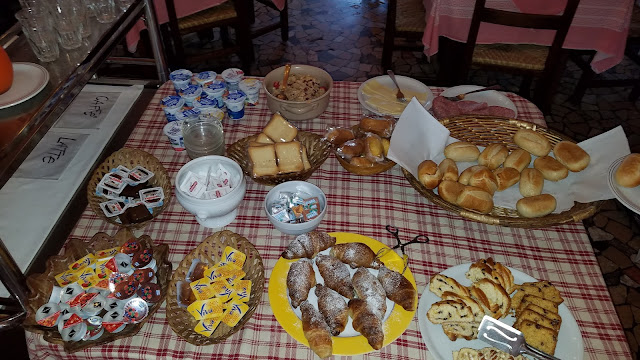
First to breakfast...
 |
| Breakfast – A Buffet |
Breakfast was okay, “a buffet,” though they didn’t replenish it as
fast as we were cleaning it out (especially certain items...), but I can’t say
we left hungry.
After breakfast, I get ready to leave, pack my bike onto the car, and we head
off towards the famous Stelvio.
The drive takes almost two hours, and my adrenaline is steadily building the
whole time.
For those less in the know, Passo dello Stelvio is the second-highest paved
mountain pass in Europe, standing at 2760m (depending on where you look, the
height ranges from 2757m to 2762m—let’s settle on 2760m).
The highest paved pass in Europe is Col de l’Iseran, which is about 7m higher
than Stelvio—you get to the popular ski resort of Val d’Isère in France, then
climb about 1000m and there you are (there’s no higher paved pass on the
continent, though there are higher roads that can take you to a peak and back,
but no higher passes).
The road over Stelvio was built by Austria, and whenever I hear Austria and
roads in the same sentence, it feels natural to mention Maria Theresa.
God, that woman was responsible for some incredible construction projects in
our region! :)
But this road was actually built after her death, long after her various
construction feats :).
Austria wanted to connect its then-province of Lombardy closer to the empire's
center.
The pass is open from May to November each year.
It rises nearly 1900m in altitude—the exact figure is about 1870m from the
roundabout where the climb begins up to the summit.
I arrive in the parking zone... of course, no spaces. Everything’s full. Try
here, try there—nothing.
Luckily, during one of my attempts, a spot opens up, and I pounce on it
immediately before someone else grabs it.
Parked.
Bike unloaded and ready.
Outside, it’s a pleasant 25-26°C.
I change.
Put on my short (summer) jersey.
I’m debating what to take with me. A wave of minimalism hits me, considering
the serious climb ahead.
What I do bring is water—a decent amount (I don’t know what awaits me on the
way, or if there will be any place to refill, so I bring almost 4 liters, just
to be safe) and a 100g Milka chocolate bar in case I get hungry.
 |
| Three Liters of Water in the Bag and One in the Bottle—Milka Alpenmilk Peeking Between the Bottles |
Mira insisted I take a pair of sweatpants, so I reluctantly stuff
them in the side pocket of my bag, just in case.
Besides the short-sleeve jersey I’m wearing, I pack a thin windbreaker in the
bag, and that’s it.
Off I go... finally...
I feel a sense of relief—there’s no turning back now...
It’s a few kilometers from the car to the start of the climb, just enough time
to warm up.
 |
| A View Towards Passo Dello Stelvio – Never Once Did It Hint at What Was Cominga |
I reach the roundabout. Okay, this is it, let’s go!
 |
| Only 200 meters to the roundabout |
 |
| The roadside "artworks"—photographing them without warning apparently costs money, for reasons I’ll never understand |

Right near this "museum," the incline tightens to 7-8%, and I think, oh boy, here we go, the real climb begins!
The road follows a river that has an unusual color...
 |
| River with an intriguing color |
 |
At the 9 km mark, I reach a place called "Gomagoi." Here, the incline tightens to over 10%. The architecture and the neatness of the houses clearly indicate that Switzerland is very close. On the other hand, this was once part of South Tyrol, Austrian territory, which Italy managed to “snatch” from Austria at the end of World War I. Fierce battles were fought over every pass and strategic position.
 |
| A typical Alpine house, perfectly maintained, with the obligatory flowers in the windows or on the balcony |
 |
| And of course, the classic combination of wood and stone as natural building materials |
Even today, the majority of the population here speaks German (Austrians), and all the signs are bilingual (Italian/German).
The town has a fork in the road: turn left to reach a ski resort (the road ends there, no further). I continue straight, and soon the town is out of sight.
11 km from the roundabout, I reach the first switchback, marked number 48.
 |
| Switchback 48 |
All the switchbacks up to the summit are numbered, with 48 being the lowest and number 1 just before the top.
 |
| The incline is decent, but I’m not giving up! |
Time passes, and I keep climbing, but the cloud situation continues to deteriorate...
 |
| Anyone normal would be concerned at this point... but there’s no turning back now... |
 |
| Trafoi |
 |
| First sign of trouble—rain on the horizon |
Oh well, it’ll be easier next time—I know where to find water now!
 |
| The pass is somewhere far in the distance... It looks mystical and far away.... |
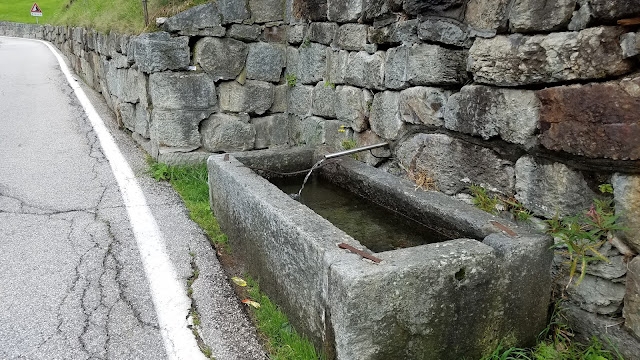 |
| A water fountain—I stop for a few sips, perfect... |
But yes!!!
Unfortunately :((((
By now, I’m too far from the village to find shelter, so I throw on my windbreaker and keep going. The rain gets heavier and heavier, turning into a full-on downpour, and soon it’s a torrential downpour.
I’m completely soaked.
From Trafoi, there were only two switchbacks (48 and 47), but after the village, the real series of switchbacks begins.
 |
| The incline is serious |
 |
| The road is completely wet (and so am I, dripping), slowly drying out, humidity at 100% |
 |
| One by one, the switchbacks are being conquered |
Mount Ortler is now the highest peak in the Eastern Alps, and back then, it was the highest in the Austro-Hungarian Empire.
 |
| The obelisk, now part of a hotel terrace |

 |
 |
| 10-15 minutes after the rain, the sun is shining, as if nothing ever happened |


 |
| The hotel at switchback 22 |
While debating whether to pop into the restaurant, I start to feel hungry (breakfast now feels like a distant memory). So, I open the Milka chocolate with the intention of eating just one row. Alas, what one row? I devoured the whole thing in one go, nearly inhaling it—it was unplanned (the idea was for it to last...). I drink some water to wash down the chocolate and keep going.
After the hotel, the switchbacks start up again, one after another, zig-zagging upwards... I have the impression the incline is getting steeper, staying around 9-10%, maybe more. It’s not pleasant, but I keep pedaling from one switchback to the next, sometimes even managing to cover two at a time.
 |
| I’d say these are endless switchbacks, but since they’re numbered, you can clearly see your progress |
 |
| Two consecutive switchbacks where the incline is over 10% |

 |
| The hotel from a distance, or rather, from a height |
However, the terrain is completely unsuitable for solving problems of this magnitude—not a bush in sight, let alone something bigger. I keep going, looking for a suitable spot, even considering turning back to the hotel, but it’s already too far away, and that would waste too much time.
 |
| I Stop and Consider My Options—What to Do, How to Handle This |
 |
| 16 switchbacks left to the summit, altitude 2320m |
Problem solved...
Honestly, with the stomach issue behind me, I hadn’t even noticed that the sun had disappeared again and clouds were gathering. Now that the problem was out of the way, I realized it was about to rain again... But hey, I survived it once today, I can do it again.
 |
| "Here we go again..." |
But it’s not rain...
And it’s not snow...
Frozen raindrops—snowy white pellets—are falling. They fall harder and harder, like millions of tiny ping-pong balls bouncing off me, off the road, surreal. I’ve never experienced anything like this. My helmet resonates with the tapping of frozen rain.
 |
| Frozen raindrops on my bike bag |
As they fall, they start melting—on the road, on my bag, on my clothes, wherever they land. But this is nowhere near as intense as the downpour I survived (I can confidently say) back above Trafoi.
 |
| Low clouds from which the frozen rain pours relentlessly |
 |
| In the distance, I can barely make out the summit (the END) through the clouds, but there’s still a long way to go |
 | |
| It’s frozen, but once it falls, everything is wet |

 |
| View of the valley, the hotel is visible far in the distance |
I climb slowly, the switchback numbers are down to single digits. Even the strange rain gradually eases and eventually stops. Just a bit more, I tell myself...
 |
| Everything is wet |
 |
| It’s getting lighter, and now I can see the valley better |
 |
| Only 3 switchbacks left, and you can see the END just above them |
 |
| A phenomenal view of the switchbacks, but... oh no, a C L O U D!!! |
I hop on the bike and push as hard as I can...
It’s a race against the cloud!
Do I even stand a chance?!?
 |
| Reached the summit, the cloud reached it too—home team vs. visitors: 1:1 |
Now I’ve got a mission: buy a few fridge magnets and a postcard (for Mira), take some pictures, and then head down.
But there’s a surprise: the cloud brought snow with it!
 |
| The summit, souvenir shops everywhere |
I can’t believe it—I’m still in my short-sleeve jersey, with just a thin windbreaker on top, but I’m completely soaked (from head and hair down to my toes), partly from the various rains I encountered along the way and mostly from sweat.
I walk into a shop, buy the fridge magnets and a postcard. I ask the shopkeeper for a plastic bag to pack the postcard since everything is wet. Of course, she obliges without any issue.
I step outside, mission accomplished! The snow is falling harder, and the shops are quickly packing up everything outside. It feels like, in just 5 minutes, the whole place has shut down and gone quiet.
I wonder what to do next... All the bad weather I’ve encountered so far has lasted relatively briefly (about 15-20 minutes, after which the weather changed quickly), so I think maybe I’ll wait for 15 minutes—perhaps the sun will come out.
I notice a stand by the road where two guys are grilling and selling sausages. I park my bike next to the stand... It’s past 3 p.m. now, and breakfast (like the dearly departed) is fondly remembered, while that chocolate which caused so many problems was good enough to stave off hunger. But now, as I catch the scent of freshly grilled sausages, I’m reminded that I’m actually really hungry.
 |
| It’s clear I’ll eat the sausage standing up (I won’t sit since the benches are covered in snow) |
 |
| Cheerful guys grilling sausages I ponder which one to get. I ask, “Which one’s the best?” |
 |
| A closer look at the menu |
Five minutes later, the sausage has become part of history.
 |
| Just 5 Minutes Later and My Bike Has Turned White |
As time passes, the snow intensifies, falling thicker and thicker. Meanwhile, I’m getting colder and colder (while waiting for the snow to stop), and slowly, the cold really starts to set in.
I’m trying to figure out what to do...
 |
| A proper snowstorm, like something out of a ski trip to Jahorina—only this time, it's August |
 |
| The snow keeps falling, and I’m starting to get the impression it won’t be stopping anytime soon. |
 |
| But it’s still melting as soon as it hits the ground… A few cyclists show up, soaked to the bone (just like me), and without hesitation, they dive into the first souvenir shop they see and buy winter gloves. I thought to myself, “Not a bad idea,” so I jump in as well and buy a pair of ski gloves (the most expensive gloves I’ve ever bought—25 EUR—but totally worth it). I ask the saleswoman to pack them in a plastic bag. She pulls out a small one, just big enough for the gloves, and I ask, “Do you have a bigger bag?” Of course, she does, and she packs the gloves in a larger bag. In reality, I didn’t need a bag for the gloves; I needed it for my head, which was completely soaked (from rain, sweat, snow...). I step out of the shop, take off my helmet, put the bag on my head, and put the helmet back on. Much better, at least for my head. I slip on the ski gloves, and things improve even more. I pull out the sweatpants from my bag (Mira, THANK YOU—turns out I was way too stubborn, and luckily, you were more persistent than me). Sure, they’re thin summer sweatpants, but after more than half an hour in 0°C weather in a wet summer outfit, they feel like a blessing. I manage to put them on, although I’m already frozen stiff and clumsy from the cold. I look around, and the snow shows no sign of letting up. In fact, it’s falling even harder, and I notice that it’s starting to stick to the road. The thought crosses my mind: “What if it starts to freeze on the road? There’s no way I’ll be able to descend...” In that instant, taking photos and admiring the valley lose all importance—getting down safely becomes my only priority. I hop on the bike, and after spending 35 minutes at the summit, hoping the snow would stop, I cautiously begin the descent (my tires were pretty bald and due for replacement, which didn’t help matters). |
 |
| At the start of the descent, I test how slippery it is and how the bike behaves when I brake (it’s slick, but if I brake carefully, I can descend safely) |
 | ||
The same scene as 45 minutes ago when I saw the cloud speeding in (only now the color scheme is "black & white")
|

I descend very cautiously and slowly. There’s 1-2 cm of snow on the road, depending on the spot. I’m braking constantly and making gradual progress. The cold is unbelievable, but I have to admit the bag, gloves, and sweatpants make the descent much more bearable.
Ten minutes later, the snow disappears, and I can relax and ride faster, braking more sharply before each switchback. Now, there’s a serious amount of water on the road—the snowstorm up top translated into a heavy downpour down here. My legs are soaked from the knees down, and as for my shoes—let’s not even talk about it (the front wheel splashes water despite the fenders, spraying it on the bike frame and onto my legs from both sides; the faster I ride, the worse it gets).
 |
| Up top, everything’s white, but here, the grass is starting to turn green |
 |
| Switchback 22, the hotel again, and you can still see the white summit in the distance |
 |
| A few patches of blue sky here and there |
 |
| The descent continues, now with no issues |
I reach the car, and Mira and Nikola burst into laughter when they see me (and I can’t blame them): bag on my head, the bag’s handles sticking out, blown by the wind, wearing ski gloves, sweatpants all wet and muddy. I say, “SORRY, I didn’t plan for it to take this long, but there were a few things I had to deal with along the way.” Of course, down here, the temperature is over 20°C, and I’m talking about some crazy snow up there—they can’t believe it until I show them the pictures.
I change into dry clothes, pack the bike onto the car, and we slowly head back to our hotel.
What can I say in the end? An extraordinary experience, full of twists and obstacles, but I managed to overcome them all. Honestly, I don’t think I’ve ever been so cold in my life as I was on this ride.
But it was worth it!
And I’ll definitely ride Stelvio again, as soon as I get the chance.
We arrive at the hotel and have dinner. And I still can’t figure out the snow?! According to the Stelvio forecast, it wasn’t supposed to be colder than 15-16°C. Then it hit me—the weather station I’d been checking was in Trafoi, and I’d been looking at the forecast for the wrong altitude the entire time.
Later, I found data from the actual weather station at the summit, which showed that daytime temperatures on the summit were around 2-5°C, and at night, they dropped below freezing. If only I’d had this forecast earlier, I definitely would’ve dressed better... But I got through it, one way or another...
Morning again.
We have breakfast, pack up, and start our drive back to Novi Sad.
 |
| Nikola vs. Nutella 15g = 10 : 0 |
 |
| The same lake from two days ago when it was cold and gloomy |


We’ll see, next time...
D.
Story from the same region: Maratonac
Story from the same region (6 years later): Passo dello Stelvio - OSVETA
Comments
Post a Comment