Valter Defends Sarajevo – Ride 19 – 20.10.2019.
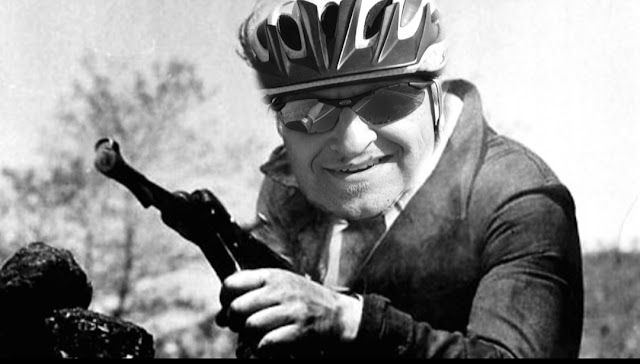 |
| My loyal Banditos were quick to "post" a picture right after my ride... their creativity is truly impressive. |
There were still a few days left until the mentioned weekend, and all the forecasts indicated that the weekend would be really nice (considering the time of year) and, above all, completely sunny...
That weekend, some of the Banditos crew planned to ride a weekend tour to the spa in Mórahalom. Brilliant!
The idea was great, but riding endlessly across the flatlands wasn't for me (it doesn't inspire me at all, quite the opposite), so I told them that I’d probably ride up some hill (at that moment I didn’t even know if I’d be riding, but if I did, it would definitely be a hill—just didn’t know which one yet).
I had a few options for which hill I could tackle... Then an idea that had been on my mind for a while popped up: ride to Sarajevo via Vlasenica, Han Pijesak, and Sokolac (i.e., over Romanija). I’d been waiting for the stars to align for this kind of ride, and it finally felt like the moment had arrived. The climb up Romanija from Vlasenica had always seemed pretty serious to me (having driven it many times), and honestly, I saw Vlasenica as a real challenge.
I started thinking that this might be the weekend (maybe) to ride to Sarajevo, but it was tight. The days were already noticeably shorter (it starts getting dark around 6 p.m.), the mornings and evenings were cold (especially by the rivers), but during the day it could be perfect for riding (neither too hot nor too cold—just right).
Considering all that, Sarajevo seemed a bit out of reach, and I figured I should pick a shorter route more appropriate for the time of year.
I consulted with Mentor and Lauda, laying out my idea to ride from Bašta to Sarajevo (around 200 km, with over 3000 meters of elevation), eat some ćevapi, sleep over, and then head back the next day via a different route to keep things interesting.
The idea passed through "parliament" without much disagreement, and we made the final decision—WE'RE RIDING!!!
Fantastic!
More than fantastic!
The plan was standard:
- Friday: After work, I’d travel to Bašta.
- Saturday: Early rise, prep for the ride, breakfast, then ride (~200 km): BB - Ljubovija - Vlasenica - Sokolac - Sarajevo, dinner, sleep.
- Sunday: Early rise, prep for the ride, breakfast, then ride (~185 km): Sarajevo - Sokolac - Rogatica - Višegrad - Kotroman - Kremna - BB, and when I get back to Bajina Bašta, I’d pack up and drive back to NS.
As always, whenever I visit a city or town where I know people, I make sure to give them a heads-up…
From earlier times, I knew Adnan and Nenad in Sarajevo. Two amazing guys, real Sarajevans, what we’d call true raja. They were complete opposites—one was fire, the other water; one was young, the other retired; one was a devout Muslim, the other Orthodox—but none of that mattered at all to them (or to me) when it came to being best buddies... I’ve hung out with them many times (in fact, every time I go to Sarajevo), and I was really looking forward to seeing them again.
As soon as Mentor, Lauda, and I finalized our plans, and I had a rough idea of all the key details, I called Adnan to let him know we’d be arriving in Sarajevo on Saturday evening and to see if we could meet up. Naturally, my suggestion was accepted in the first microsecond, without any objections.
I said to Adnan, “Adnan, I’ve eaten all kinds of ćevapi in Sarajevo, but I’ve never tried the ones at Željo. I’d love it if, when we meet up, we could go there for some ćevapi (we’ll probably be seriously hungry by then), so I can see why some people rave about them while others criticize them.”
This is the classic "10 in half with onions..."
On the internet, there’s a real mini-WAR over which ćevapi are the best in Sarajevo, and people are more or less split into two camps: Ferhatović vs. Željo, roughly 50/50. (Not to say it’s purely a matter of taste—there’s more to it that isn’t related to the kitchen or the spices…).
As far as I’m concerned, they’re all good; it’s all about the little details (especially when you’re hungry—there’s not much difference at that point...).
Then Adnan said something completely unexpected: “NO chance!”
I thought he was joking, so I said, “Seriously, I want to try the ćevapi at Željo.” I mean, it’s not some outrageous, unachievable wish to eat ćevapi at a specific place.
But Adnan responded, “M-A, N-O C-H-A-N-C-E!!!!!”
OK, now I could tell from his tone and the way he was speaking that he wasn’t joking.
I tried reasoning with him in different ways… NO WAY!
As they say, the proposal was off the table.
It took me a few minutes of conversation to finally figure out what the problem was:
You see, Adnan is a passionate supporter of Sarajevo (the football team), and Željo is a ćevapi restaurant associated with FK Željezničar, Sarajevo’s rival football club. Now, as someone who’s completely anti-football (I don’t follow it, nor do I give it any importance in my life), this kind of emotion seemed totally surreal to me, but I had to accept the harsh reality that it wasn’t surreal for Adnan. This Sarajevo-Željezničar rivalry was serious, like the rivalry between Red Star and Partizan in Belgrade, only I got the impression that here it was even worse, with an extra dose of fanaticism.
He said, “If anyone saw me sitting at Željo’s eating ćevapi, I might as well move out of Sarajevo immediately…”
OK, I grasped the magnitude and the stakes of this (unexpected) game called "ćevapi at Željo," but I was still persistent, unwilling to give up on my mission to eat at Željo (I mean, come on, Sarajevo-Željezničar, who cares? We’re just going for food, right?!?!?). In the end, Adnan relented and said:
“Look, across from Željo there’s a café called Havana. We often sit there (not to say drink), it’s got a nice vibe, so we’ll sit outside at a table in front of Havana, and we’ll order ćevapi from across the street. They’ll bring it over without any problem. That way, we’re not sitting at Željo, but we’ll still eat their ćevapi.”
“OK,” I said, “Deal!”
As they say, both the wolf and the sheep are satisfied... Finally!
The weekend was approaching, and I started thinking about finding accommodation for Friday night in Bašta, but then Mentor suggested I stay at his place (Igor’s room was free anyway). I said, “Thanks, but there’s no need. I’ll stay with Milan at Mystic River, just need to check if he’s got a free room.” But Mentor insisted—he wouldn’t hear of me not staying at his place.
After a short "battle," Mentor won...
So now it was: Home Team vs Guests = 1:1
I arrived in Bašta—Friday night.
Sleep.
- SATURDAY, 19.10.2019. -
We woke up around 7 a.m. (getting dressed for the ride).By 7:40 a.m., we were off, and in about 5 minutes, we met up with Lauda in the center of Bašta.
The first stop was the exchange office, where I changed euros into Bosnian marks, because I’d need them.
 |
| Outside the exchange office, it was that crisp, autumn chill in the air, but we were well dressed for it. |
Then came the bakery, where, among other things, they made komplet lepinje.
 |
| Bakery |
 |
| We hadn’t even properly started yet, and we were already stopping for a break, but no ride begins without breakfast... |
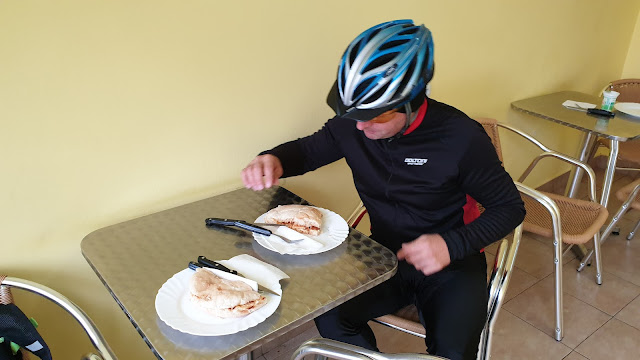 |
| To fuel ourselves for the ride, we each ate half a komplet lepinja. |
We set off, well, almost.
Of course, the little house on the Drina was a must-see and an unavoidable stop.
We paused briefly for photos and then moved on.
Now we were REALLY off… Finally!
 |
| Hahaha, taking pictures with the little house on the Drina |
 |
| Another selfie(ish) with the house on the Drina, and we’re ready to go |
 |
| Mentor, me, and the house on the water |
 |
| Intersection at Rogačica (left to Ljubovija, right to Užice) |
 |
| The weather was still “meh” |
 |
| A little after 9 a.m., the morning mist started to give way, and the sun began to shine through. |
 |
| Finally, we could see the Drina |
We rode on, keeping a good pace, and in about 2 hours, we arrived in Ljubovija. Just before the border, there was a shop, so we stopped there for a quick 5-minute break, grabbed a drink (had to replenish some of that lost sugar...), and then continued on. The border was just 30 meters from the shop, on our side of the bridge.
 |
| We crossed into Bosnia (Mentor ahead and Lauda closer to me). |

 |
| Entering Bosnia |
The burek was excellent! It lived up to expectations.
We continued toward Milići.
There was a slight climb, followed by a gentle descent, and at about 78 kilometers from the start of the ride, the climb towards Vlasenica began (of course, at that moment, the incline was very mild, and we were slowly climbing almost imperceptibly).
 |
| The scenery was "gently" autumnal—many of the fall colors had yet to fully reveal themselves. |
 |
| Mentor was riding a trekking bike, while Lauda and I were on road bikes. |

After two short breaks, we arrived in Milići. Milići is known for its large bauxite mine, from which aluminum is processed. In the village center, there's a plateau where the mining machines are displayed, and they are all quite impressive in size (although, having worked in the Majdanpek and Bor mines, I’ve seen much larger machines, but these still command respect).

 |
| Mentor and a digger |
 |
| One relatively small dump truck, knowing the size of some others |
 |
| Bulldozer |
After a serious "photo session" with the mining equipment, it was time to take off some layers since it wasn’t as cold as in the morning (although still not warm enough for short sleeves). But from Milići, the real climb to Vlasenica begins, so we knew we’d warm up, and a short-sleeved jersey wouldn’t be an issue.
 |
| Shortly after Milići, the incline became visible in the distance—it was time to start climbing! |

Vlasenica isn’t a big place, so we passed through it quickly, and then the REAL climb began.
 |
| Just passed Vlasenica—a view of part of the town from above |
 |
| Then came the stunning views of nature, mountains, and forests. |
 |
| The climb was in full swing—I spent more time looking around and enjoying the scenery than focusing on the road. |
Mentor and I maintained a reasonable pace given the circumstances, while Lauda, being Lauda, sped ahead to set a good time on some uphill segment (honestly, I expected nothing less from him)...
 |
| Soon, all the mountains surrounding us seemed to shrink in comparison, and the vistas stretched farther and farther. |

 |
| At some point, autumn really started to show in the treetops. |
 |
| This is one of the reasons we came here (well, one of them... :) ). |
 |
| On this hairpin curve, there’s a rest area called Vrelo—naturally, we stopped for some water and a short break. |
 |
| Vrelo |

Our eyes were "full" of colors...
It felt like plugging into "fast charge."
As Branko Kockica would say, “A vitamin for the soul.”
And indeed, it was a vitamin for the soul...
Now, more than two years after the ride, that vitamin is still in me, and some part of that vitamin will, hopefully, pass on to the readers as well.

 |
| Unfortunately, the photo doesn’t capture the view of the mountains and landscapes stretching for kilometers into the distance (the contrast between shadows and bright scenery in the distance here favors the shadows). |
 |
| Simply—AUTUMN |
 |
| Simply—CAN’T GET BETTER |
 | ||||||
Just a bit more, and we’re close to the top
 There was another water fountain there, but we didn’t need it since we had "topped up" at the one on the hairpin about 4 km back. A little over a kilometer later, we had conquered Vlasenica.  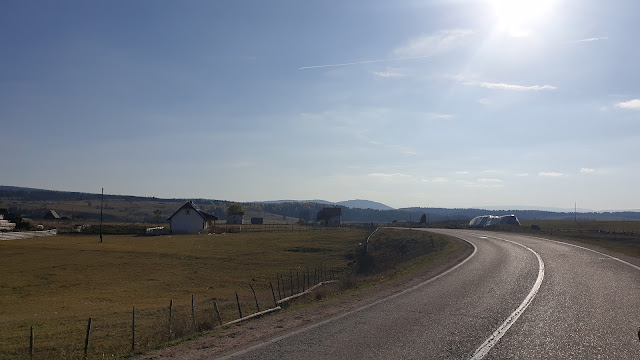 Once you finally reach the top, there’s a plateau. I’d compare it to Vojvodina raised to over 1000 meters above sea level, but it’s not quite like that. It is a plateau, but still quite hilly—our Vojvodina is much flatter (not to say completely flat). I was expecting a bigger "resistance" from Vlasenica Hill (36 km of climbing, either gentle or steep, with 1000 meters of elevation). Yes, there’s climbing to be done, but it’s not too bad. In fact, it’s quite the opposite. I’ve tackled far tougher climbs than this one.  The landscape changed so suddenly, it was incredible how, in just a few minutes of riding, we transitioned from the beautiful “fast charging” forest to a “plain” (almost dull, but fortunately, it wasn’t completely flat here, so it remained interesting).  Very quickly after we completed the climb, we began the descent toward Han Pijesak, arriving shortly after. We stopped in Han Pijesak for a break to grab something to eat. We each had a banana and shared a two-liter bottle of Coca-Cola, evenly split. A short rest and a small snack, just what we needed...
After our break, we continued toward Sokolac. We rode non-stop for about 40 km. At the exit of Sokolac, at the “T” intersection, we turned right toward Sarajevo, and the climb to Ravna Romanija began immediately. For some unknown reason, I found the climb difficult. Not in terms of my legs, but my heart rate was unusually high, so I told Lauda and Mentor to go ahead without me. I didn’t want to push myself too hard. And so it was. They sped off, while I made sure not to let my heart rate spike. At one point, I stopped to take a few photos.   I continued, and the incline gradually eased, allowing me to speed up. I caught up with the group about 7-8 minutes later; they had already sat down at the Peđa restaurant and ordered coffee. Just as I sat down, the waiter came by with their coffee, so I ordered a Coke to "clear out the engine."    It was time for a break... The descent from Romanija was perfect, with the sun’s position and the autumn colors aligning to create another “fast charging” effect (this is the "fast charging" forest—part two).      You can see from the photos that sunset was approaching... At 6:07 p.m., we arrived at the agreed meeting point (in front of the Vijećnica building).
 We used those 10 minutes to put on warmer clothes and take a few pictures here and there. The sun had set, and the temperature was dropping fast, and we were cooling down. I called the guy at our accommodation to let him know we had arrived in Sarajevo (just so he knew we made it, as he seemed a bit skeptical when I told him our plan for getting to Sarajevo). I told him we’d grab something to eat and be there in about an hour and a half, maybe two at most. He said, “OK, I’ll be waiting for you.” |


 |
| The Banditos in Baščaršija |
Honestly, after all that trouble, I was exhausted, but I was determined to finally eat Željo’s ćevapi...
I hoped it would be worth it.
 |
| I took a picture of Adnan with Željo in the background, just to tease him a little... |
In the blink of an eye, after we ordered, the ćevapi arrived. Well done (of course, they’re grilling constantly, whether they need to or not, since people are always coming in to order while others finish and leave, so it’s like a conveyor belt, just with a bit more chaos—but surprisingly, it works perfectly).
 |
| Ten in half with onions—enough said. |


 |
| This is the "forbidden" zone (at least when Adnan is with us). |
 |
| Café Havana saved the day. |
The ćevapi disappeared in an instant.
As expected... Our last serious meal was around 10:30 a.m. in Bratunac (the burek), so of course, we were hungry...
Naturally, with the ćevapi came conversation, sharing life experiences (as I like to say, our talk went from the beginning of the universe to the present and back). We chatted, laughed—there was no end in sight...
After three rounds of drinks and one round of ćevapi, I said, “Guys, I’m still hungry...”
I could tell from the looks of my comrades that I wasn’t alone in this thought...
I said, "Let’s go for a 'five-piece' at Ferhatović, just for comparison."
To be honest, I’ve never had the chance to try both kinds of ćevapi one after the other.
The proposal was unanimously accepted!
 |
| On our way from Željo to Ferhatović, we passed by a pastry shop—Ferhatović nearly fell out of the plan, but my persistence won out. |
 |
| Same crew, different location (Ferhatović) |
 |
| Five in half with onions |

I devoured Ferhatović's "five-piece" just as quickly as I had Željo’s, and if you ask me, here’s the final score:
Željo vs. Ferhatović = 0:1
Željo’s ćevapi are bigger, but Ferhatović’s taste far better in my opinion. Also, the bread (or rather, the half-portion of it) is smaller but much nicer, better baked, and crispier at Ferhatović.
Next time I’m in Sarajevo, there’s no doubt—I’m heading straight for Ferhatović…
Naturally, the conversation continued, spanning universes and other worlds, seamlessly picking up where we’d left off, completely oblivious to the change in location and ambiance.
We reached our “conclusions” here too, when Adnan suggested we go for coffee—his treat.
"Don’t, guys, please, I beg you..." (a quote from The Marathon Family). The guy from our accommodation had already called me about seven times asking when we’d arrive, and I honestly didn’t know what to tell him anymore… I think he no longer believed we were even in Sarajevo.
Who cares about the accommodation?
9:30 PM—We headed for coffee; we’d worry about where we’d sleep later.
 |
| Baščaršija Mosque |
 |
| I’d say this coffee was just how coffee should be. |
Now, I don’t usually drink coffee, so I could only observe how it’s done the right way.
Here in Baščaršija, it’s much more than just a beverage.


The conversation, laughter, and atmosphere were completely immune to the changes in location, food, or drink. Everything was at its peak.
We almost couldn’t bear to part ways…
If the guy from our accommodation hadn’t been so dramatic, we would’ve surely closed down Baščaršija.
But even as it was, it was fantastic!
10:27 PM—We finally got back on our bikes, intending to head to the accommodation. But first, a few photos by the Sebilj fountain—it’s a Sarajevo landmark, after all.
 |
| Mentor and the Sebilj fountain |
 |
| Lauda, Mentor, and the Sebilj fountain |
Of course, that couldn’t be allowed.
It was almost 11 PM, and there we were, riding circles around Sarajevo’s boulevards like lunatics, determined to clock those last 4-5 km to round the total distance to 200 km.
OK, mission accomplished, the accommodation was the next stop.
11:06 PM—we arrived at the accommodation. The guy couldn’t believe it.
"We’ve made it."
We left the bikes in the hallway of the house (ground floor) and rushed up to the third floor, where our rooms were.
 |
| 11:15 PM—view of Sarajevo from the terrace |
 |
| Upload time, while waiting my turn for the shower |
With a bit more detail: We had a small technical problem—there was no toilet paper in the house (I assume it had something to do with the landlord’s religious beliefs).
There’s a problem where you least expect it…
We “scavenged” all the toilet paper and tissues we had with us, and it was barely enough for the three of us, but the operation was ultimately a success.
Honestly, after everything, I couldn’t bring myself to go downstairs and ask the guy for toilet paper.
Barely morning.
When I got up, it was still officially dark... the light was just beginning to show below the horizon.

So, we had to start early if I was going to get everything done...
 |
| The view of the morning in Sarajevo from our accommodation was pretty nice. |
 |
| From the outside, the accommodation looked unfinished and shabby, but inside it was actually quite decent (except for the lack of a certain type of paper) |

We set off.
Our first stop was the site where Gavrilo Princip assassinated Archduke Ferdinand.
After that event, the world was never the same place...
 |
| The spot where Gavrilo Princip shot the archduke |
 |
| Memorial plaque |
 |
| Images of the event |
 |
| Images from the trial |


You can see some pictures and read a bit of text there (honestly, too little considering this was the trigger for World War I)...
 |
| Miljacka River (upstream), often sung about in songs |
 |
| The evidence of love is present on every bridge I crossed, no matter how hard the bridge builders tried to make it difficult to leave proof... Love locks always find their way onto the bridge somehow. |
 |
| Miljacka River (downstream) |
We continued, crossed the Miljacka—breakfast time!
 |
| Mentor and Lauda in action |
When we say burek, it means with meat (what we call burek with meat here, which would actually translate to (burek with meat) with meat, so basically—a pleonasm).
A pie with cheese is called sirnica, with greens it’s zeljanica, etc.
I don’t know what they call these new varieties with mushrooms, pizza flavor, or, God forbid, chocolate or apples...
Now, when you walk into a bakery or burek shop in Bosnia and ask for burek with cheese, the salesperson’s fuse instantly blows—they roll their eyes, and at the very least, their short-circuit protection kicks in, because it simply doesn’t compute.
How no one has yet thought to make a burek with both meat and cheese, I don’t know—it would probably solve the problem of the burek with cheese dilemma in Bosnia.

 |
| According to Neša and Adnan’s recommendation—this is the place to eat burek, sirnica, or zeljanica. |
The recommendation we received about where to eat breakfast was spot on—it was excellent. Honestly, it couldn’t have been better.
I suggested we swing by the Sebilj fountain again, this time during the day (I mean, it was just a few hundred meters from the bakery).
The proposal was accepted.
 |
| Sebilj – Bathed in the Morning Sun |

We filled our water bottles there, as is customary… After all, that’s what it’s for.
Now for a bit of history and geography:
Sebilj is an Arabic word meaning "a building along the road where water is available," a fountain of a unique shape, often found in public squares, where a sebiljdžija would fetch water from the basin and offer it freely to the thirsty.In Sarajevo, during the Ottoman period, there were several sebiljs, but all of them were destroyed in the fire of 1697. The only remaining sebilj in Baščaršija, in its current form, was built in 1913.
The sebilj in Baščaršija was originally commissioned by the Bosnian vizier Mehmed-pasha Kukavica in 1753. That sebilj was located slightly lower than the current one and was destroyed in a fire in 1852. Kukavica's sebilj was finally torn down in 1891, for reasons unknown.
Based on designs of sebiljs from the 16th century, architect Aleksandar Wittek designed the new sebilj, which was built in 1913 and still adorns Baščaršija and Sarajevo today. This part of Baščaršija is often referred to as Pigeon Square.
The first restoration of the sebilj was done in 1981, with minor interventions in 1984 ahead of the Winter Olympics held in Sarajevo. Due to shelling in 1992, the sebilj was damaged by shrapnel, and minor repairs were made in 1997, when the mušepci (wooden lattice) were repaired, and the wooden structure was repainted. In 2006, the sebilj underwent a more thorough restoration: the copper roof was replaced, the water supply and drainage were repaired, and the wood was treated for protection.
There is a replica of the Sarajevo sebilj in Belgrade, gifted by the city of Sarajevo in 1989. Another replica stands in St. Louis, a gift from the Bosnian-Herzegovinian community to the city on its 250th anniversary. There’s also a replica in Novi Pazar, a gift from Sarajevo, the capital of Bosnia and Herzegovina.
 |
| There are no more sebiljdžijas—so we have to pour the water ourselves :) |


 |
| Last look at the still-asleep Baščaršija |
OK, breakfast done, we visited some significant spots, filled our water bottles, and now we’re leaving Sarajevo...
 |
| The last signs of civilization, also known as Sarajevo |

When we came out of the tunnel, it felt like we’d traveled 100 km away. Cliffs, rocks, nature—nothing like the big city we had just left (in fact, we had entered the Miljacka River canyon).
 |
| We came from down there, from Sarajevo, and after passing through this tunnel, the scenery completely changed. |
 |
| The canyon is beautiful, especially in this morning sun. |
 |
| The first 10 kilometers or so, we rode in the shade. |
Everyone was still asleep (deep down, I felt like it was “just to spite me!”).
But it didn’t matter—we were up and on our way, no turning back now.
The morning temperature was a pleasant 2.5°C, and fortunately, we were climbing, so we weren’t completely frozen (except for my feet—I couldn’t feel them from the cold, as I was wearing summer cycling shoes). We stopped at a gas station before the turn toward Romanija to grab a coffee, where I tried to warm up my feet as much as possible.
 |
| Temperature—feels more like January or February, not October. |


 |
| We sped down here yesterday into Sarajevo; now we have a nice climb ahead. |
In reality, we’d been climbing since we started, so we warmed up, and the temperature wasn’t too much of a problem. As we climbed and gained altitude, the views became even more beautiful, stretching farther and farther.

 |
| A magical forest on the horizon. |


And then again, the “fast charging” forest, bathed in morning sunlight, from a completely different angle.
 |
| Of course, the autumn colors were not lacking. |

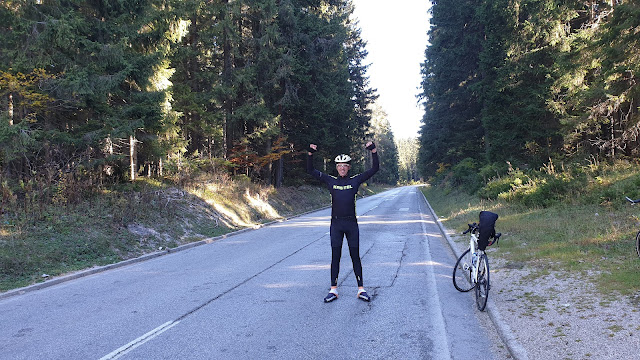 |
| Lauda posing in the middle of the road—nobody around (definitely, Sunday mornings are the best for cycling in Bosnia). |
The climb from Sarajevo to Ravna Romanija isn’t difficult. Sure, there’s some pedaling to be done, and it’s uphill, but nothing too bad. We reached the Peđa restaurant, where we took a break yesterday, and then continued down toward Sokolac. Very quickly, we arrived at the "T" intersection near Sokolac, but this time we went straight toward Rogatica.
 |
| Again, the plateau effect—though it’s hilly, and the road constantly goes up and down. |
 |
| Kalimero probably lives here (the older, or rather, much older generation will understand why…). |


 |
| The road reminded me of the Greek letter epsilon ξ (more specifically, how Professor Dr. Ilija Kovačević would draw it on the board during Mathematical Analysis 1—anyone who studied electrical engineering in Novi Sad will know what I’m talking about). |
 |
| Nature is treating us to stunning views and interesting terrain on all sides. |

A little before noon, we arrived in Rogatica (having covered just over 70 km). We passed a bakery in the center of town, and my stomach started calling. We entered the bakery and found a decent selection of pastries, especially pies.


Buying food at the bakery and drinks at the store—time for a lunch break (somewhat unplanned, but perfectly timed).
After the break, we continued, and very shortly after leaving Rogatica (a kilometer or two), nature was back in full force. We had entered the Rakitnica River canyon, where there’s no industry polluting the environment—everything is pure and pristine. The views were incredible. While we had previously enjoyed sweeping vistas and lookouts from higher up, now we were deep in the canyon, surrounded by a river bordered by steep cliffs and untouched nature.
 |
| We left Rogatica and entered the Rakitnica Canyon. |


 |
| Rakitnica – It’s not a big river (at least not this time of year, though I’m sure it’s a different story when the snow melts), but it’s completely untouched and authentic. |
 |
| Rakitnica |
 |
| The canyon is breathtaking. |
We’re maintaining a great pace since we’re riding "down the river." I’ve never been to this part of Bosnia before, so I’m spending more time looking around than focusing on the road (which isn’t a problem, as the road quality is quite solid).


Rakitnica flows into the Drina, and our fast descent ends where Rakitnica merges with the Drina. At the point where we hit the Drina, you can "feel" the influence of the Višegrad Dam—the reservoir has slowed and tamed the otherwise wild and winding Drina.

However, even this lake has its own beauty and charm.
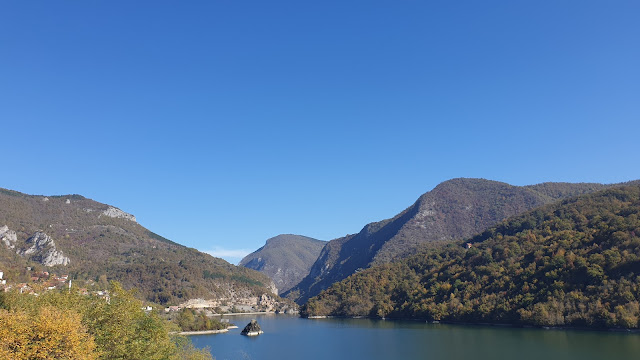

 |
| Where the Lim River (center of the image) merges with the Drina |
The Drina itself is a stunning river, which collects many beautiful rivers and streams along the way, making it even more magnificent...
Near the spot where the Lim flows into the Drina is the Brodar tunnel, where the film "Lepa sela lepo gore" was shot.


 |
| The view is simply gorgeous. |
We take a short break here, snap some photos, and slowly continue on.


 |
| Now, that’s how you park a truck! |

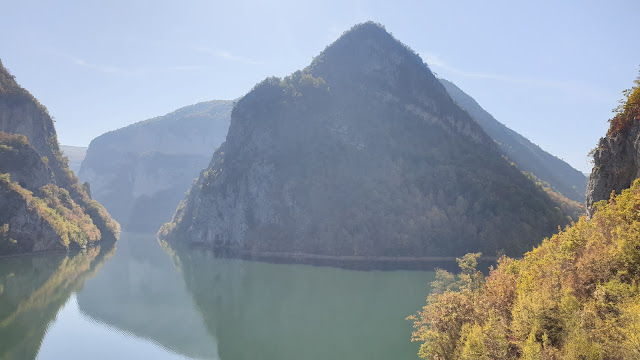
About 7 km from where the Lim flows into the Drina is the Višegrad hydroelectric plant, and 10 km from the confluence is the famous Bridge on the Drina.
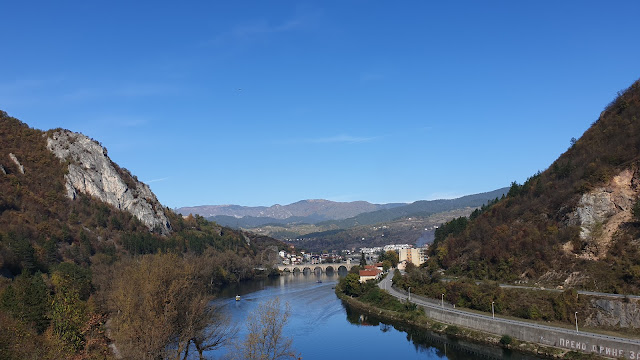 |
| A distant view of the bridge |
 |
| Getting closer to Višegrad |

We passed through Višegrad without lingering and continued towards Dobrun and Serbia. After Dobrun, we entered the stunning canyon of the Rzav River.
 |
| Canyon of the Rzav River |


 |
| Entering Serbia |

We rode towards Mokra Gora and stopped in front of a store (142 km from this morning). Ahead of us was the climb to Mokra Gora and, after that, the ascent to Tara.


We tackled the climbs routinely (first Mokra Gora, then the climb to Tara).
We reached Kaluđerske Bare, and from there, it was all downhill...
What followed was a phenomenal descent (15 km downhill, dropping 800 meters in elevation).
Back in Bajina Bašta, once again!
 |
| Another shot with the little house on the Drina (actually the first clear one, since there was fog yesterday morning). |
This was, without a doubt, one of the most beautiful rides I’ve ever had the chance to experience.
I’m absolutely certain we’ll repeat it if the opportunity ever arises.
Until the next ride,
D.
Comments
Post a Comment